
Bhutan Road Trip: Epic One-Week Travel Itinerary Through the Land of the Thunder Dragon!
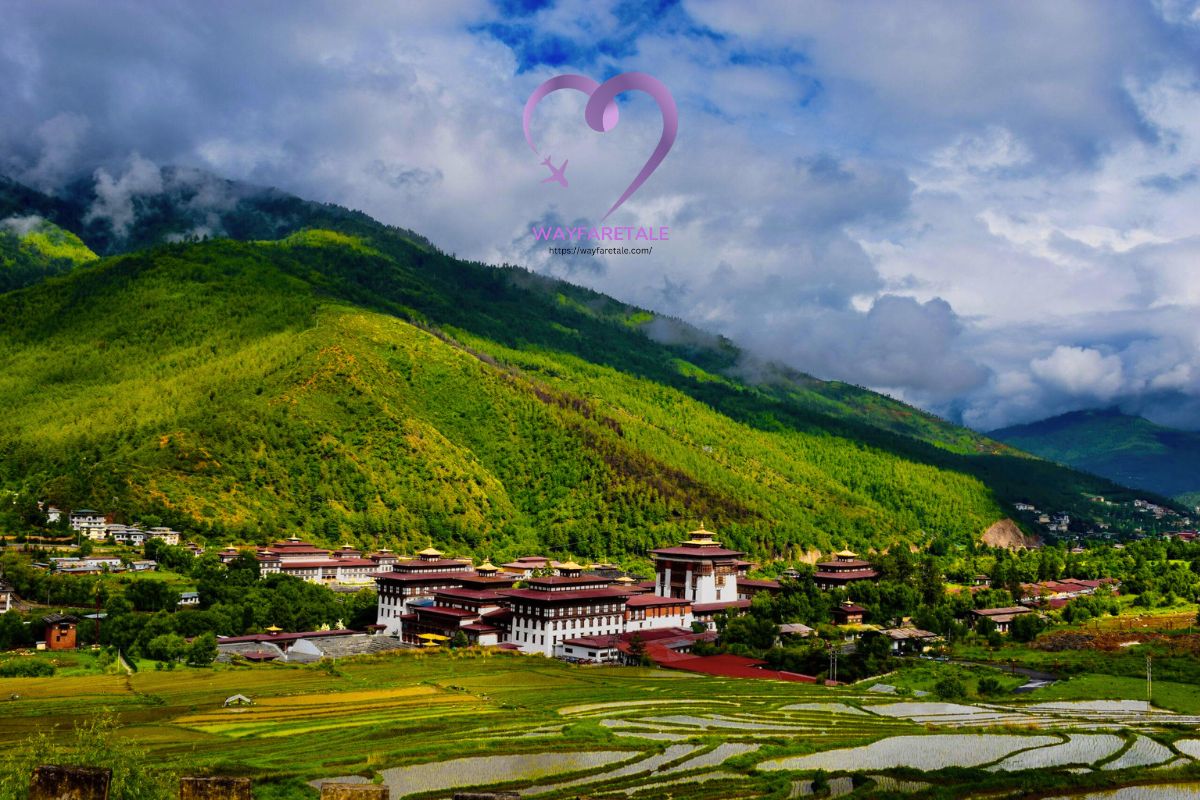
Bhutan, the Land of the Thunder Dragon, is a mystical Himalayan kingdom perfect for an unforgettable road trip adventure. This detailed one-week Bhutan road trip itinerary covers the best places in the country that you can explore in 7 days.
Bhutan is a small Buddhist kingdom with an astonishing amount to discover! Winding mountain roads traverse through ancient dzongs (fortresses), sacred monasteries perched on cliff faces, pristine valleys dotted with prayer flags, and breathtaking Himalayan passes. Therefore, embarking on a Bhutan road trip is by far the best way to explore this incredible kingdom that measures Gross National Happiness instead of GDP.
With your own vehicle and driver (required by law in Bhutan), you will be able to explore the best places in Bhutan conveniently. While Bhutan’s tourism model includes mandatory guided tours, having a private vehicle allows you to customize your pace and make spontaneous stops at viewpoints, monasteries, and local villages that would otherwise be missed.
Based on my experience visiting this enchanting country, I put together this comprehensive one-week Bhutan road trip itinerary covering the western valleys, including Paro, Thimphu, Punakha, and the stunning Phobjikha Valley. It indicates distances traveled, provides an interactive approach to planning, and suggests the best places to stay in Bhutan.
Important Travel Tips:
- Tour Operator: All tourists must book through a licensed Bhutanese tour operator or international partner. They arrange your visa, accommodation, transport, and guide. I recommend researching operators through the Tourism Council of Bhutan’s official website.
- Sustainable Development Fee (SDF): Bhutan charges a daily SDF of $100 USD per person (as of 2023) which supports free healthcare, education, and environmental conservation.
- Driver & Guide: By law, all tourists must travel with a licensed guide and driver. This actually enhances the experience as local guides provide invaluable cultural insights.
- Stay: Your tour operator will arrange accommodation, typically including a mix of hotels and traditional farmhouse stays.
- Travel Insurance: Purchase reliable travel insurance at Heymondo or SafetyWing before your trip.
- Best Tours: Your licensed guide will arrange monastery visits, cultural experiences, and treks included in your package.
Summary of My Bhutan Road Trip Route
- Day 1: Paro Arrival, Paro Town Exploration
- Day 2: Tiger’s Nest Monastery (Taktsang) Hike
- Day 3: Paro to Thimphu via Tamchoe Monastery and Chuzom Confluence
- Day 4: Thimphu Sightseeing (Buddha Dordenma, Tashichho Dzong, Memorial Chorten)
- Day 5: Thimphu to Punakha via Dochula Pass
- Day 6: Punakha Valley (Punakha Dzong, Chimi Lhakhang, Suspension Bridge)
- Day 7: Punakha to Paro via Phobjikha Valley (optional extension)
If I had 5 Days in Bhutan, my itinerary would include: Paro (Tiger’s Nest)- Thimphu- Dochula Pass- Punakha Dzong.
If I had 10 Days in Bhutan, I would add: Phobjikha Valley- Gangtey Monastery- Bumthang Valley- Trongsa Dzong.
Bhutan Road Trip Planning Tips
Hiring a Vehicle and Driver in Bhutan
Unlike most destinations, you cannot rent a car and drive yourself in Bhutan. All tourists must travel with a licensed driver and guide as part of their tour package. Your tour operator will arrange a comfortable SUV or minivan with an experienced driver who knows every hairpin turn and mountain pass.
This might seem restrictive, but it’s actually a blessing. Bhutan’s mountain roads are challenging, often single-lane with steep drops and no guardrails. Having a skilled local driver allows you to relax and enjoy the spectacular scenery without stress.
Driving Conditions in Bhutan
Bhutan’s roads wind through some of the most dramatic mountain terrain in the Himalayas. The main highways connecting major towns are generally well-maintained, though narrow and winding. Secondary roads to remote monasteries and villages can be rough, especially during monsoon season (June-August).
Distances on paper appear short, but mountain driving is slow. Expect to average 30-40 km per hour on winding roads. A 60 km journey might take 2-3 hours. Roads often close due to landslides during monsoon, so flexibility in your itinerary is essential.
The spectacular views make every kilometer worthwhile. Around every bend, you’ll encounter prayer flags fluttering in the wind, traditional farmhouses, and jaw-dropping Himalayan vistas.
Where to Stay During Your Bhutan Road Trip
Your tour operator will arrange all accommodation as part of your package. Most travelers stay in comfortable 3-4 star hotels in major towns like Paro, Thimphu, and Punakha. These typically feature traditional Bhutanese architecture with modern amenities.
I always request a mix of hotels and farmhouse homestays when booking my Bhutan tours. Staying in a traditional farmhouse gives authentic insight into Bhutanese rural life. You’ll sleep in rooms with hand-painted Buddhist motifs, warm yourself by a bukhari (wood stove), and share meals with your host family.
Key factors when your operator selects accommodation:
- Proximity to major sights to minimize driving time
- Comfort level appropriate for mountain travel
- Authentic Bhutanese architectural style
- Good heating (essential in winter months)
Here’s a quick summary of accommodation during my road trip:
Hotel List:
- Paro – Zhideyling Resort or Tashi Namgay Resort (2 nights)
- Thimphu – Hotel Phuntsho Pelri or Peaceful Resort (2 nights)
- Punakha – Meri Puensum Resort or Dhensa Boutique Resort (2 nights)
- Farmhouse Stay – Traditional homestay in Punakha or Phobjikha Valley (1 night)
What to Expect in Bhutan?
In Bhutan, you will be transported to a land where ancient Buddhist traditions thrive in modern times. Prayer wheels spin constantly at temple entrances, monks in maroon robes debate philosophy in monastery courtyards, and every mountain pass is adorned with thousands of colorful prayer flags carrying blessings on the wind.
You’ll witness the architectural masterpiece of Punakha Dzong seemingly floating at the confluence of two rivers, challenge yourself on the steep climb to Tiger’s Nest Monastery clinging impossibly to a cliff face 900 meters above the valley, and find peace in the pristine Phobjikha Valley where endangered black-necked cranes winter among traditional villages.
The Bhutanese people, known for their warmth and happiness, will welcome you into their homes, share butter tea and red rice, and explain Buddhist teachings that have shaped their nation. You’ll discover a country that has deliberately chosen cultural preservation and environmental conservation over rapid development, resulting in a carbon-negative nation where Gross National Happiness is taken seriously.
How Many Days Do You Need in Bhutan?
Based on my experience, one week in Bhutan is the minimum to experience the western valley highlights without feeling rushed. This allows time for proper acclimatization (Paro is at 2,200m elevation), the essential Tiger’s Nest hike, and exploration of Thimphu, Punakha, and potentially Phobjikha Valley.
However, Bhutan deserves more time if you can spare it. Two weeks allows exploration of central Bhutan including Bumthang Valley, often called the spiritual heartland. Three weeks opens up eastern Bhutan and remote treks.
The Sustainable Development Fee encourages longer stays—many visitors stay 7-10 days to maximize their investment while the daily fee supports Bhutan’s free healthcare, education, and environmental programs.
When to Visit Bhutan?
The best times to visit Bhutan are during the shoulder seasons: March to May (spring) and September to November (autumn). These months offer clear skies, comfortable temperatures, and excellent visibility of the Himalayan peaks.
Spring (March-May): The valleys explode with rhododendron blooms, particularly spectacular at higher elevations. Temperatures are mild (15-25°C in valleys), though nights remain cool. This is peak season, so book well in advance.
Autumn (September-November): Considered the absolute best time. After monsoon, the air is crystal clear with stunning mountain views. Autumn is festival season—experiencing a tshechu (religious festival) with masked dances is unforgettable. The Phobjikha Valley welcomes black-necked cranes in November.
Summer (June-August): Monsoon season brings heavy rains, landslides, and obscured mountain views. However, valleys are lush, wildflowers abundant, and tourist numbers lower. If you don’t mind rain and can be flexible with plans, summer offers deals and authenticity.
Winter (December-February): High passes may be snow-blocked, but valleys like Punakha remain accessible with clear skies and comfortable daytime temperatures. Winter is low season with fewer tourists and the chance to see snowcapped peaks in brilliant clarity.
Budget for Your Road Trip in Bhutan
Bhutan is unique in that all tourists (except Indian, Bangladeshi, and Maldivian nationals) pay a daily package rate that includes:
- Accommodation (3-star or better)
- All meals
- Licensed guide
- Private vehicle and driver
- Internal permits
- Most entrance fees
As of 2023, the minimum daily package is approximately $250-290 USD per person for groups, including the $100 Sustainable Development Fee. Solo travelers pay a surcharge. Luxury accommodations increase the rate significantly.
Additional costs to budget:
- International flights to Paro
- Travel insurance
- Alcoholic beverages and soft drinks (not included in meals)
- Tips for guide and driver ($10-15/day total is customary)
- Souvenirs and handicrafts
- Optional activities (hot stone baths, archery, rafting)
While Bhutan isn’t a budget destination, remember that your daily fee supports free education, healthcare, and environmental conservation, and ensures Bhutan remains unspoiled.
Bhutan One-Week Road Trip Itinerary Day by Day
Day 1: Arrival in Paro – Exploring the Valley (Altitude: 2,200m)
Distance covered: 15 km
Total drive time: 30 minutes
Overnight in: Paro (2 consecutive nights)
Landing at Paro International Airport is an adventure itself—only a handful of pilots are certified to navigate the challenging approach through Himalayan valleys. As your plane descends, watch for the white-walled Paro Dzong perched above the valley and terraced rice fields stretching along the Paro Chhu river.
After immigration and meeting your guide, you’ll head to your hotel in Paro town. Don’t push too hard on your first day—the 2,200m elevation requires acclimatization. I spent my first afternoon gently exploring Paro town and resting before tomorrow’s demanding Tiger’s Nest hike.
Things to Do in Paro Town
Explore Paro’s Charming Main Street
Paro town is delightfully walkable with its traditional architecture required by law. Every building features white-washed walls, colorful wooden windows, and sloping roofs painted with Buddhist motifs. The main street is lined with handicraft shops selling hand-woven textiles, traditional masks, prayer wheels, and singing bowls.
I wandered into several shops, chatting with friendly owners who explained the symbolism in thangka paintings and demonstrated hand-weaving techniques passed down through generations. Don’t rush—shopping in Bhutan is about cultural exchange, not aggressive salesmanship.
Visit Rinpung Dzong
Paro’s imposing fortress-monastery, Rinpung Dzong, dominates the valley. Built in 1644, this magnificent structure houses both monastic body and district administrative offices—typical of Bhutanese dzongs. Cross the traditional cantilever wooden bridge draped with prayer flags to enter.
Inside, massive courtyards are surrounded by multi-story buildings with intricate woodwork and paintings depicting Buddhist teachings. During my visit, monks were practicing ritual horns for an upcoming festival, the deep resonating sound echoing off ancient walls.
USEFUL TIP: Visit Rinpung Dzong in late afternoon when tour groups have departed. The golden hour light illuminates the dzong beautifully, and you might catch monks in evening prayers. Entrance is included in your tour package, but dress modestly—no shorts or sleeveless tops.
National Museum of Bhutan
Housed in the Ta Dzong (ancient watchtower) above Rinpung Dzong, the National Museum provides essential context for understanding Bhutanese culture. Collections include ancient thangkas, traditional weapons, natural history exhibits, and galleries explaining Bhutan’s unique development philosophy.
The circular architecture of the watchtower itself is fascinating—spiral galleries wind upward through six floors. Take your time here; the museum offers insights that will deepen your appreciation of everything you’ll see throughout your journey.
Evening Stroll Along Paro Chhu
As sunset approached, I walked along the Paro Chhu river where locals gather after work. Elderly men spin prayer wheels while chatting on benches, children play archery (Bhutan’s national sport), and women in traditional kiras stroll home from the market.
This is real Bhutanese life, unhurried and content. My guide explained that Bhutan’s emphasis on Gross National Happiness isn’t just philosophy—it’s evident in how people interact, always with time for connection and laughter.
Where to Stay in Paro
Paro offers excellent accommodation options from comfortable hotels to luxury resorts. I stayed at Zhideyling Resort, a beautiful property built in traditional Bhutanese style with contemporary comforts. Each room features hand-painted Buddhist motifs, a bukhari (traditional wood stove), and mountain views.
The resort’s restaurant serves both Bhutanese and international cuisine—I recommend trying ema datshi (chili and cheese curry) on your first night to prepare your palate for Bhutan’s famously spicy cuisine!
Other excellent options include Tashi Namgay Resort (mid-range with lovely gardens) or for luxury, Amankora Paro or COMO Uma Paro.
Day 2: Tiger’s Nest Monastery (Taktsang Goemba) Hike
Distance covered: 20 km (to trailhead and return)
Hiking distance: 8 km round trip
Total time: 5-7 hours (hiking only)
Elevation gain: 900 meters
Overnight in: Paro
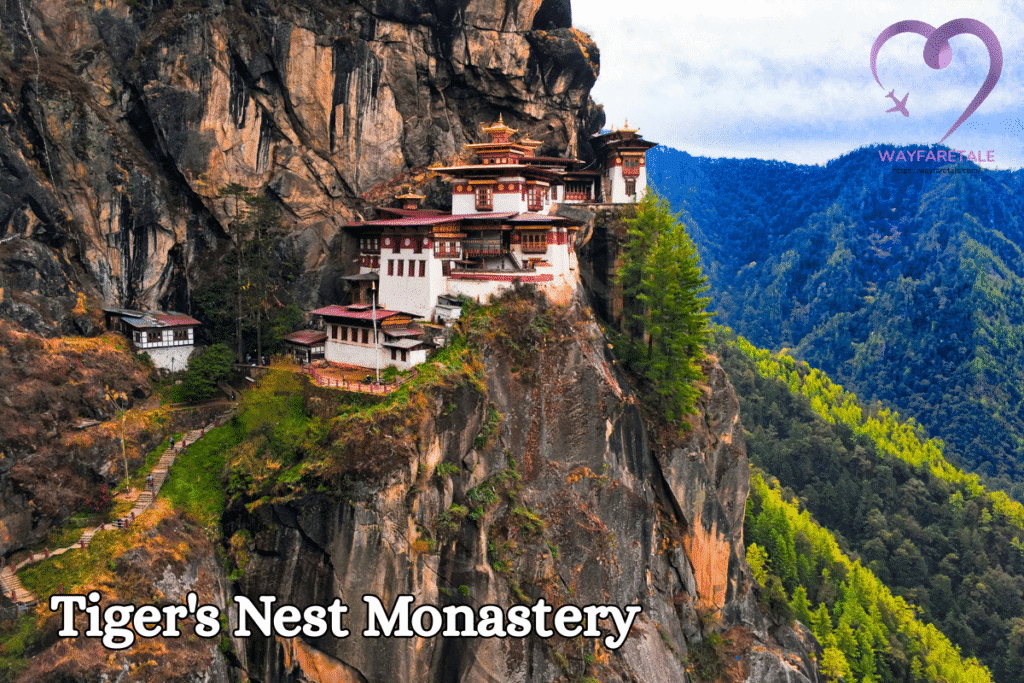
Today is the highlight of any Bhutan trip—hiking to the legendary Tiger’s Nest Monastery, one of the most sacred Buddhist sites in the Himalayas. This iconic monastery clings impossibly to a cliff face 900 meters above the Paro Valley, seemingly defying gravity.
According to legend, Guru Rinpoche (who brought Buddhism to Bhutan in the 8th century) flew here on the back of a tigress, meditated in a cave for three months, and subdued demons. The monastery built around this sacred cave has been a pilgrimage site for over 1,300 years.
USEFUL TIP: Start early! I began at 7 AM to avoid afternoon heat and clouds that often obscure views. The trail gets crowded by mid-morning with tour groups.
The Tiger’s Nest Trek Experience
The trail begins at the parking area with immediate steep climbing through blue pine forest. Don’t be discouraged by the relentless uphill—pace yourself and take breaks to catch your breath and admire opening valley views.
After about 45 minutes of huffing and puffing, you’ll reach a cafeteria viewpoint where Tiger’s Nest first comes into dramatic view across the gorge. This is where you realize the magnitude of what builders accomplished centuries ago without modern equipment. Grab a sweet milk tea here and absorb the view.
HORSE OPTION: Less fit visitors can hire horses for the first section up to the cafeteria (not included in tour package, approximately $20-25 USD). However, horses cannot go beyond this point, and the most spectacular section—the steep descent and final ascent to the monastery—must be completed on foot.
From the cafeteria, the trail becomes more dramatic. You’ll descend steeply through prayer flag-draped forest, cross a waterfall gorge via bridge, then begin the final steep ascent of over 200 stone steps to reach the monastery entrance.
Inside Tiger’s Nest
At the monastery gate, you must store cameras, phones, and bags—no photography allowed inside (strictly enforced). Remove shoes and enter quietly as this is an active monastery where monks live and practice.
The interior is breathtaking. Dimly lit chapels contain ancient statues, butter lamp offerings casting flickering light on elaborately painted walls, and the sacred cave where Guru Rinpoche meditated. The smell of burning juniper incense and the murmur of monk’s prayers create an atmosphere of deep spirituality.
My guide explained the significance of each chapel, the symbolic meanings in the paintings, and stories of Guru Rinpoche’s miracles. This cultural context transformed the experience from sightseeing to spiritual journey.
The Descent
Coming down is faster but requires concentration—the stone steps can be slippery, especially if afternoon clouds bring moisture. Most trekkers complete the round trip in 5-6 hours total, including time at the monastery.
Back at the parking area, my legs were trembling, but I felt profoundly accomplished. Tiger’s Nest is challenging, but reaching this sacred site is an experience you’ll carry forever.
PACKING TIPS FOR THE HIKE:
- Sturdy hiking shoes with good grip
- Layered clothing (morning is cold, midday hot)
- Sun protection (hat, sunscreen, sunglasses)
- Water (2 liters minimum) and snacks
- Camera for outside monastery
- Walking stick (available to borrow at trailhead)
- Light rain jacket (weather changes quickly)
Day 3: Paro to Thimphu via Tamchoe Monastery and Chuzom (55 km, 1.5 hours)
Distance covered: 55 km
Total drive time: 1.5-2 hours
Overnight in: Thimphu (2 consecutive nights)
After yesterday’s strenuous hike, today’s journey to Thimphu is relatively relaxed. The drive follows the Paro Chhu and then Thimphu Chhu rivers through stunning valleys where traditional farmhouses dot terraced fields.
TAMCHOE LHAKHANG (TACHOG LHAKHANG DZONG)
About 20 minutes from Paro, make your first stop at Tamchoe Lhakhang, a small monastery built by the legendary bridge-builder Thangtong Gyalpo in the 15th century. What makes this spot special is the traditional iron chain bridge spanning the river.
Thangtong Gyalpo built 108 iron bridges across Bhutan and Tibet—this is one of the few remaining examples. Walking across the swaying bridge hung with prayer flags, with river rushing below, is thrilling. The monastery itself, though small, contains beautiful murals and statues.
PHOTO TIP: The bridge photograph beautifully from the hillside above the monastery. The combination of iron chains, prayer flags, river, and monastery creates quintessential Bhutan imagery.
CHUZOM CONFLUENCE
Continue to Chuzom, where three rivers meet and three-style stupas (Tibetan, Nepalese, and Bhutanese) symbolically unite Buddhist traditions. This is a popular photo stop where travelers make offerings at the stupas and circumambulate clockwise while spinning prayer wheels.
My guide explained that confluences hold special significance in Bhutanese culture—the meeting of waters is considered auspicious. We spent 20 minutes here watching pilgrims, locals, and fellow travelers spin prayer wheels and add stones to the mani walls (walls made of stones carved with Buddhist mantras).
Arriving in Thimphu
As you approach Thimphu, the valley opens and you’ll notice Bhutan’s capital is unlike any other. There are no traffic lights (the single one installed was removed because locals preferred the friendly traffic policeman directing traffic with elaborate hand gestures). Buildings rise to 5-6 stories but all maintain traditional architecture with painted wooden facades.
Thimphu sits at 2,320m elevation in a wide valley. With a population around 115,000, it’s simultaneously capital city and overgrown mountain town—a unique blend of governmental importance and small-town charm.
First Afternoon in Thimphu
After checking into your hotel, I recommend a gentle introduction to the capital. Walk to the weekend vegetable market (if it’s Thursday-Sunday) where farmers from surrounding valleys sell organic produce, dried yak cheese, handwoven baskets, and traditional textiles.
The market is authentically local—this is where Thimphu residents shop, not a tourist market. Watching transactions conducted in Dzongkha, seeing elderly women in traditional dress selling chili peppers while gossiping, and observing the incredible variety of red rice and buckwheat reminds you that despite being a capital, Thimphu remains deeply connected to agricultural traditions.
Evening on Norzin Lam
Thimphu’s main street, Norzin Lam, comes alive in the evening. Families stroll, groups of teenagers hang out, and shops stay open late. I spent my first evening wandering, stopping at the Bhutan Post Office to create custom stamps with my photo (a popular souvenir), and browsing bookshops full of Buddhist texts and Bhutanese literature.
For dinner, try authentic Bhutanese cuisine at Folk Heritage Museum Restaurant or if you’re craving variety after spicy Bhutanese food, numerous restaurants serve Indian, Chinese, and continental cuisine.
Where to Stay in Thimphu
Your tour operator will arrange Thimphu accommodation. I stayed at Hotel Phuntsho Pelri, a comfortable mid-range hotel with traditional architecture, central location, and helpful staff. The hotel’s bukhari-heated rooms were cozy during cool April evenings.
Other good options include Peaceful Resort (beautiful valley views), Hotel Druk (central location), or for luxury, Le Méridien Thimphu or Pemako Punakha (actually in Punakha but worth mentioning).
USEFUL TIP: Request a room facing away from Norzin Lam if you’re a light sleeper—the main street can be noisy until late, especially weekends.
Day 4: Thimphu Sightseeing – Capital City Highlights
Distance covered: 35 km (within Thimphu valley)
Total drive time: 1.5 hours (between sites)
Overnight in: Thimphu
Today is dedicated to exploring Bhutan’s unique capital—a city that has no traffic lights, where civil servants wear traditional dress to work, and where ancient Buddhist traditions coexist with modern governance.
BUDDHA DORDENMA STATUE
Start your day early at the colossal Buddha Dordenma, a 51-meter gilded bronze statue overlooking Thimphu valley. Built to fulfill an ancient prophecy and commemorate the 60th anniversary of the fourth king, this is one of the largest Buddha statues in the world.
The drive up the winding road to Kuensel Phodrang (Buddha Point) takes about 15 minutes from central Thimphu. As you ascend, the capital spreads below in an expanding panorama of traditional architecture nestled in the valley.
What makes Buddha Dordenma extraordinary isn’t just its size—the statue contains 125,000 smaller Buddha statues, each also gilded in gold. The interior chapel (open to visitors) houses these countless Buddhas in floor-to-ceiling niches, creating an overwhelming sense of devotion and artistry.
USEFUL TIP: Come early morning around 7-8 AM for the best light and fewer tourists. The morning sun illuminates the golden Buddha brilliantly, and you’ll often have the meditation hall nearly to yourself. The views of Thimphu valley from here are spectacular—bring your camera!
I spent an hour here, not just photographing but sitting in quiet contemplation. The peaceful atmosphere, prayer flags fluttering in mountain breeze, and the sheer presence of the Buddha create a meditative experience. Local devotees circumambulate the statue clockwise, spinning prayer wheels—join them to experience this moving ritual.
MOTITHANG TAKIN PRESERVE
From Buddha Point, drive to the Motithang Takin Preserve to see Bhutan’s national animal—the bizarre and endearing takin. This unusual creature looks like someone combined a goat and a cow, with a moose’s nose thrown in for good measure.
According to legend, the “Divine Madman” Lama Drukpa Kunley created the takin from bones of a goat and cow after eating them for lunch, demonstrating his supernatural powers. Whether you believe the legend or not, takins are real, endangered, and found only in the Himalayas.
The preserve is small, basically a forested hillside enclosure where takins roam semi-wild. I watched these peculiar animals munching bamboo and grass, seemingly unbothered by observers. They move with unexpected grace despite their ungainly appearance.
PHOTO TIP: The takins are most active in early morning and late afternoon. Midday they tend to rest in shade, making photography challenging. Use a zoom lens as you can’t enter the enclosure.
TRADITIONAL PAPER FACTORY (JUNGSHI HANDMADE PAPER)
Next, visit a traditional paper-making factory to see ancient techniques still practiced. Bhutanese paper, made from daphne bush bark and edgewort bush, has been produced for centuries for religious texts and official documents.
At Jungshi Handmade Paper Factory, workers demonstrate the entire process: cooking bark, pounding it to pulp, spreading it on screens to dry, and finally cutting and packaging the finished paper. The paper is incredibly durable—some religious texts written on it centuries ago remain intact.
You can try your hand at paper-making (they’ll guide you through spreading pulp on a screen) and purchase beautiful handmade paper products—prayer books, calendars, lampshades, and stationery. These make meaningful souvenirs supporting traditional crafts.
I bought several notebooks made from natural daphne paper, some with flower petals pressed into the surface. Writing on this paper connects you to centuries of Bhutanese scholarship and Buddhist learning.
NATIONAL TEXTILE MUSEUM
After lunch (your guide will recommend a restaurant—try Zombala 2 Restaurant for excellent Bhutanese fare), visit the National Textile Museum. This might sound dry, but textiles are fundamental to Bhutanese culture and this museum is fascinating.
Bhutan’s traditional clothing—gho for men, kira for women—is required for civil servants and encouraged for all citizens. The textile museum displays the incredible artistry of Bhutanese weaving: intricate patterns, natural dyes, and techniques passed through generations.
The exhibitions explain the symbolism in different patterns, regional weaving styles, and the social significance of textiles. Some displayed textiles are centuries old, masterpieces of artistry and craftsmanship. You’ll gain deep appreciation for the beautiful traditional dress you see everywhere in Bhutan.
USEFUL TIP: If textiles interest you, ask your guide to arrange a visit to a weaving workshop where you can see weavers creating intricate patterns on back-strap looms. Watching the complexity of their work is mesmerizing.
TASHICHHO DZONG
Late afternoon is perfect for visiting Tashichho Dzong, Thimphu’s most impressive fortress-monastery and seat of Bhutan’s government. This massive whitewashed structure with golden roofs houses the throne room and offices of the king, the ministries of home affairs and finance, and the central monastic body.
Built in 1641 and extensively renovated in the 1960s, Tashichho Dzong is a masterpiece of traditional architecture. Massive courtyards surrounded by multi-story buildings with elaborately painted wooden balconies, all without a single nail (traditional construction uses intricate joinery).
IMPORTANT: Tashichho Dzong is only open to tourists after 5 PM on weekdays (after government offices close) and all day on weekends. Dress modestly—long pants, no shorts, covered shoulders, and remove hats. Your guide will have the timing planned correctly.
Walking through the massive courtyards as evening light illuminates the golden roofs is magical. During my visit, I glimpsed monks preparing for evening prayers, the deep sound of dungchen (ceremonial horns) echoing off ancient walls.
From Tashichho Dzong, you can walk to the riverside where locals play archery—Bhutan’s national sport—on traditional ranges. Watching the skill of archers hitting targets 145 meters away with bamboo bows is impressive. If you’re lucky, a friendly local might invite you to try (don’t expect to hit anything your first attempts!).
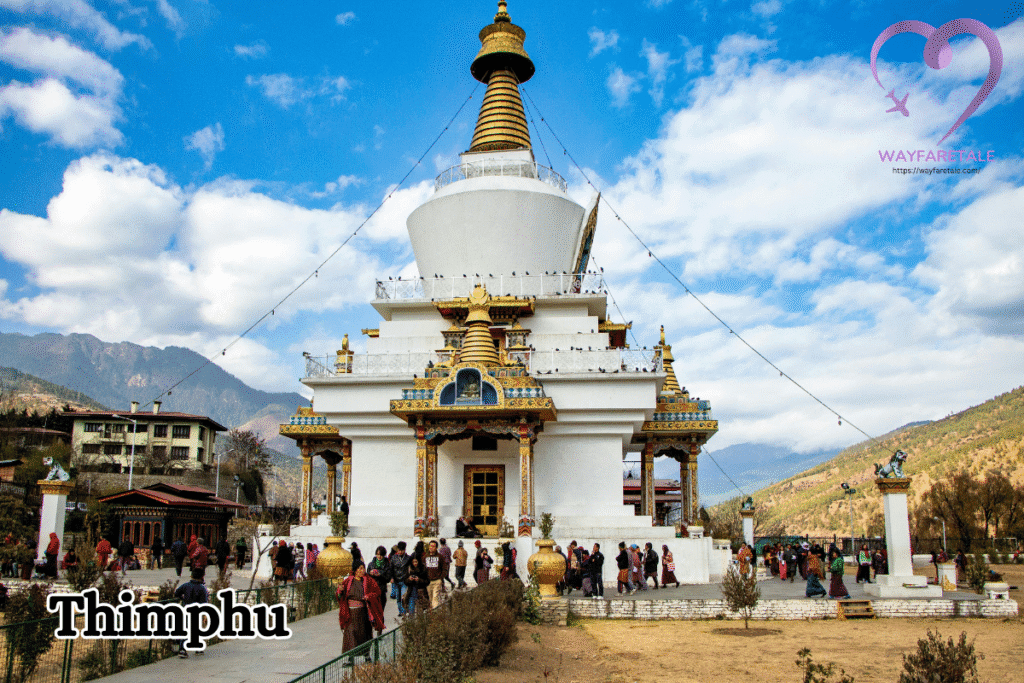
NATIONAL MEMORIAL CHORTEN
End your day at the National Memorial Chorten, Thimphu’s most important religious landmark. Built in 1974 to honor the third king, Jigme Dorji Wangchuck (the father of modern Bhutan), this chorten is the spiritual heart of the capital.
Unlike most chortens that contain relics, this one was built as a memorial and teaching stupa. The elaborate iconography inside and out is designed to teach Buddhist philosophy—my guide spent 30 minutes explaining the symbolism in the statues and mandalas.
What makes the Memorial Chorten special is watching locals here throughout the day. Elderly residents circumambulate clockwise, spinning prayer wheels and reciting mantras. Young and old come to pray, offer butter lamps, and receive blessings from monks.
I visited at sunset when the chorten is most atmospheric. The golden hour light, smell of juniper incense, sounds of prayer wheels spinning and mantras murmured, and the devotion of practitioners created a profound sense of Bhutan’s living Buddhist culture.
PHOTOGRAPHY TIP: The chorten photographs beautifully in late afternoon light. Respectfully photograph the architecture and prayer wheels, but always ask permission before photographing people in prayer—most won’t mind, but showing respect is essential.
Evening in Thimphu
For dinner, I recommend experiencing traditional Bhutanese hotpot at Benez Restaurant & Bar. Bhutanese hotpot isn’t spicy like typical Bhutanese food—it’s a communal pot of broth where you cook vegetables, mushrooms, tofu, and meat (usually yak or pork). It’s warming, social, and delicious.
If you want nightlife (don’t expect wild clubbing), Thimphu has several bars popular with locals and expats. Mojo Park and Space 34 have live music some evenings. Or simply stroll Norzin Lam, grab ice cream, and people-watch—that’s how Thimphu residents spend evenings.
Day 5: Thimphu to Punakha via Dochula Pass (75 km, 3 hours including stops)
Distance covered: 75 km
Total drive time: 2 hours driving + 1 hour stops
Overnight in: Punakha (2 consecutive nights)
Today’s journey crosses the dramatic Dochula Pass and descends into the lush Punakha Valley—one of the most scenic drives in Bhutan. The road climbs from Thimphu’s 2,320m elevation up to Dochula at 3,100m, then winds down to Punakha at just 1,200m, passing through multiple climate zones.
THE ASCENT TO DOCHULA PASS
Leaving Thimphu, the road immediately begins climbing through blue pine and rhododendron forest. The winding highway (Lateral Road connecting western and eastern Bhutan) is Bhutan’s main east-west artery, yet it’s still just two lanes of sometimes rough pavement.
During spring (March-May), the rhododendrons bloom in spectacular displays of red, pink, and white. The forest seems to glow with color. Even outside blooming season, the dense forest is beautiful, with prayer flags strung between trees and occasional farmhouses perched on impossible slopes.
The drive takes about 45 minutes from Thimphu to Dochula Pass summit. As you climb, watch for the changing vegetation—subtropical species giving way to temperate forest and finally alpine vegetation near the pass.
DOCHULA PASS – 108 CHORTENS AND HIMALAYAN PANORAMAS
Arriving at Dochula Pass is breathtaking—literally (the altitude) and figuratively (the views). On clear days, the Himalayan range stretches across the northern horizon: snow-capped peaks including Bhutan’s highest, Gangkhar Puensum (7,570m), the world’s highest unclimbed mountain (climbing mountains is forbidden in Bhutan as peaks are sacred).
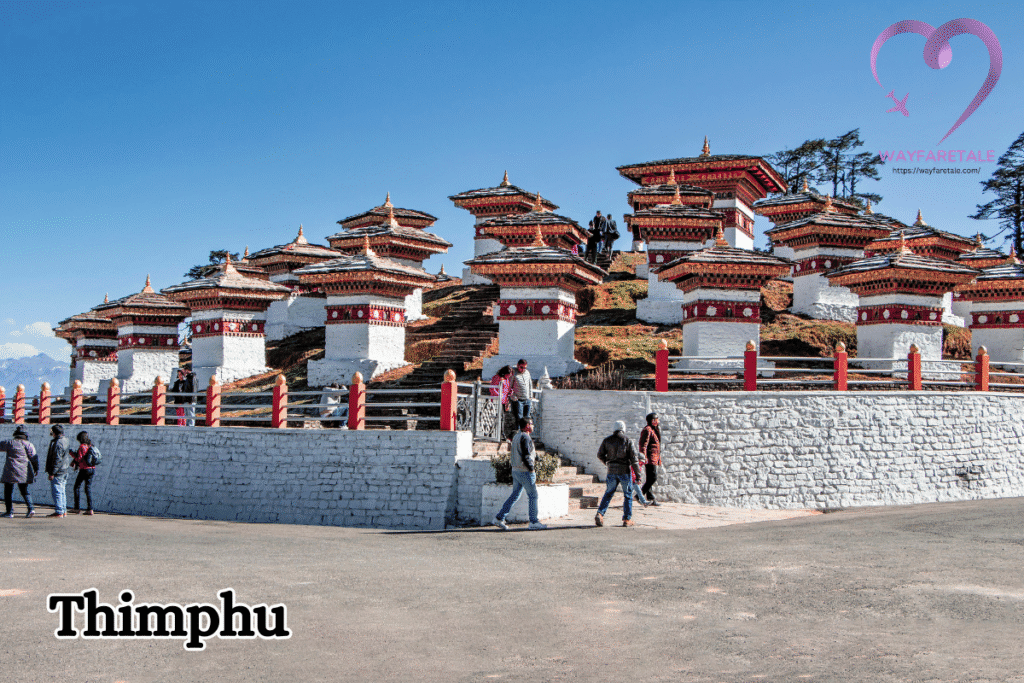
The pass is marked by 108 memorial chortens (Druk Wangyal Chortens) built by the Queen Mother to honor Bhutanese soldiers. These whitewashed stupas arranged in concentric circles create a powerful monument. Prayer flags connecting the chortens flutter constantly, carrying prayers on the wind.
USEFUL TIP: Weather at Dochula is unpredictable. Mornings are usually clearest for mountain views—clouds often roll in by afternoon. If you arrive to cloudy conditions, don’t despair. Watching clouds part to reveal Himalayan giants is magical. I waited 20 minutes and was rewarded with dramatic views as morning mist cleared.
Even in clouds, Dochula is beautiful. The mystical atmosphere of chortens emerging from mist, prayer flags disappearing into whiteness, and the silence of high altitude create a spiritual experience.
DRUK WANGYAL LHAKHANG TEMPLE
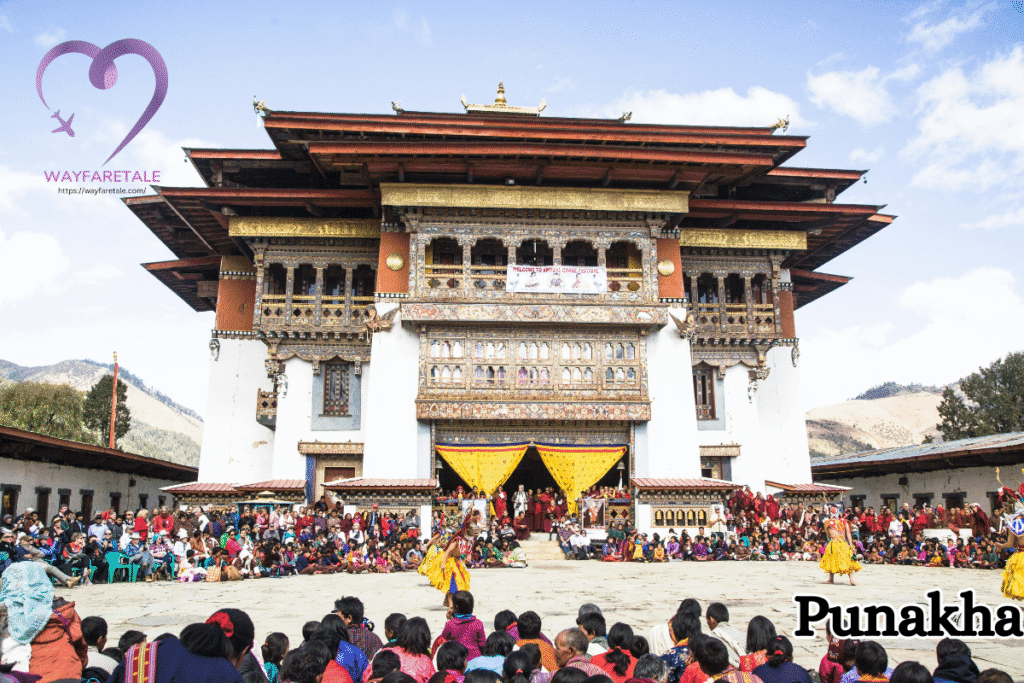
Just below the pass is Druk Wangyal Lhakhang, a stunning temple built in traditional style but opened only in 2008. The temple murals are extraordinary—instead of traditional Buddhist iconography, these modern paintings depict Bhutanese history, the kings, and the military campaign the chortens commemorate.
The main chapel contains huge statues and intricate paintings showing traditional festivals, coronations, and daily Bhutanese life. It’s a unique fusion of sacred art and national history.
The temple’s exterior architecture is also noteworthy—traditional Bhutanese design with elaborate woodwork, golden roofs, and painted eaves. From the temple courtyard, more Himalayan views open up (if weather cooperates).
Entry is free, but dress respectfully and remove shoes at the entrance. Photography isn’t allowed inside most chapels, but you can photograph the courtyard and exterior.
DESCENT TO PUNAKHA VALLEY
From Dochula, the road plunges dramatically down to Punakha. Over 40 km, you’ll descend 1,900 meters, passing through distinct vegetation zones. The temperature rises noticeably as you descend—Punakha is Bhutan’s warmest valley, nearly tropical compared to Thimphu.
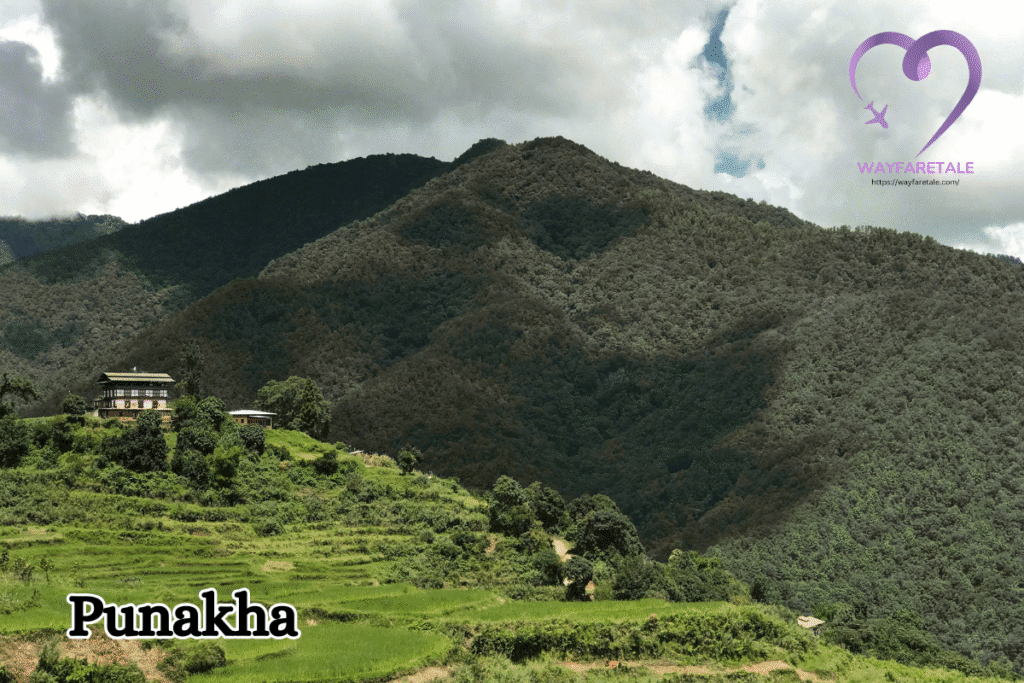
The switchback road offers continuous spectacular views. You’ll see Punakha valley spreading below, emerald rice paddies in summer, terraced fields, and the Mo Chhu and Po Chhu rivers meandering toward their confluence where Punakha Dzong sits.
About halfway down, you’ll pass through Lamperi Botanical Garden area (stop if time allows to walk forest trails) and small villages where life centers on agriculture. This descent takes about an hour with photo stops.
PHOTO TIP: There are numerous pullouts with valley views on the descent. Don’t try to photograph while driving—the road requires full attention. Your driver will stop at viewpoints when requested.
ARRIVING IN PUNAKHA VALLEY
Punakha feels completely different from Thimphu—warmer, lusher, more agricultural. Until 1955, Punakha was Bhutan’s capital (during winter months; summer capital was Thimphu). Even now, the Je Khenpo (Chief Abbot) and central monastic body relocate here each winter.
The valley produces abundant rice, vegetables, and sub-tropical fruits. You’ll notice more banana plants, orange trees, and vegetation typical of lower elevations. The slower pace and agricultural rhythm create a different atmosphere than capital city bustle.
After checking into your hotel, I suggest a relaxed afternoon. Most hotels in Punakha have beautiful riverside locations—spend time on the terrace watching the river flow by, perhaps trying a traditional Bhutanese hot stone bath (ask your hotel to arrange this therapeutic experience).
OPTIONAL AFTERNOON ACTIVITY: WALK TO KHAMSUM YULLEY NAMGYAL CHORTEN
If you’re not exhausted from hiking Tiger’s Nest two days ago, an optional afternoon walk leads to Khamsum Yulley Namgyal Chorten, a beautiful temple built in 1999 by the Queen Mother on a hill overlooking Punakha valley.
The walk begins with crossing a suspension bridge over the Mo Chhu river (prayer flags fluttering from cables), then climbing through rice fields and forest. The 45-minute hike is moderate, much easier than Tiger’s Nest, with rewarding valley views.
The four-story chorten is architecturally unique, built in traditional style without any written plans—master craftsmen worked from memory and tradition. Each floor contains elaborate paintings and statues. From the roof, panoramic views of Punakha valley spread in all directions.
I did this walk late afternoon, arriving as setting sun illuminated the valley in golden light. Few other visitors were there, and I had time to quietly explore the chorten and absorb the peaceful atmosphere. Walking back through rice paddies as farmers finished their day’s work, with Himalayan foothills silhouetted against sunset, was one of my most treasured Bhutan memories.
Where to Stay in Punakha
Punakha offers some of Bhutan’s loveliest accommodation, many with riverside locations and stunning views. I stayed at Meri Puensum Resort, a beautiful boutique hotel with spacious rooms featuring traditional architecture, comfortable beds with thick quilts, and balconies overlooking rice fields and river.
The resort’s hot stone bath facility was a highlight—sitting in wood tub filled with water heated by river stones infused with artemisia herbs, watching stars emerge as the warm water eased travel-weary muscles, was blissful.
Other excellent Punakha options:
- Dhensa Boutique Resort – Luxury property with spectacular views, infinity pool, and exceptional service
- Punakha Residency – Comfortable mid-range option in central location
- COMO Uma Punakha – High-end luxury resort with rice field views
- Zangto Pelri Hotel – Budget-friendly but clean and comfortable
DINNER TIP: Many Punakha hotels serve excellent dinners featuring local produce—red rice, vegetables, river fish. I had memorable dinners at my hotel, but if you want to venture out, Chimi Lhakhang Cafeteria near the fertility temple serves simple but authentic Bhutanese food.
Day 6: Punakha Valley Exploration – Dzong, Temples, and Village Life
Distance covered: 45 km (valley exploration)
Total drive time: 1.5 hours (between sites)
Overnight in: Punakha
Today you’ll explore the treasures of Punakha Valley—from Bhutan’s most beautiful dzong to a fertility temple beloved by couples hoping for children, and experience authentic village life.
PUNAKHA DZONG – THE PALACE OF GREAT HAPPINESS
Start your morning at Punakha Dzong, arguably the most stunning fortress-monastery in all of Bhutan. Built in 1637 at the confluence of the Po Chhu (father river) and Mo Chhu (mother river), this dzong appears to float between the two rivers, especially dramatic during spring when purple jacaranda trees bloom in the courtyards.
The approach crosses a traditional wooden cantilever bridge draped with prayer flags. As you walk across with the Po Chhu rushing below, the massive white-walled structure with golden roofs grows increasingly imposing. This is Bhutan’s second oldest and second largest dzong, serving as winter residence of the Je Khenpo and central monastic body.
USEFUL TIP: Visit early morning around 8-9 AM before tour groups arrive. The morning light illuminates the dzong beautifully, and you’ll have more peaceful time in the courtyards and chapels. Punakha Dzong is most photogenic from the suspension bridge viewpoint—allocate time after your visit to walk there.
Inside Punakha Dzong
Entering through the massive gateway, you’ll find yourself in courtyards surrounded by six-story buildings with intricately carved and painted woodwork. Every surface displays Buddhist symbolism—protective deities guard doorways, auspicious symbols decorate eaves, and murals depict teaching stories.
The dzong contains remarkable relics and sacred texts. The main chapel houses the remains of Zhabdrung Ngawang Namgyal, the Buddhist lama who unified Bhutan in the 17th century. The coronation of Bhutan’s kings takes place here in the dzong’s throne room.
During my visit, I was fortunate to witness monks in morning rituals, the sound of ceremonial drums and horns echoing through courtyards, and smell of butter lamps and incense creating an atmosphere of timeless devotion. My guide explained the significance of various statues and paintings—these narratives brought the dzong’s spiritual purpose to life.
IMPORTANT: Punakha Dzong requires modest dress (long pants, covered shoulders, no hats). Photography is prohibited inside chapels but allowed in courtyards. Your guide will lead you through and explain the significance of what you’re seeing—take your time to absorb the artistry and spirituality.
SUSPENSION BRIDGE VIEWPOINT
After visiting the dzong, walk 10 minutes to the longest suspension bridge in Bhutan spanning the Po Chhu river. At 180 meters long and decorated with hundreds of prayer flags, crossing this swaying bridge is thrilling and provides the iconic view back to Punakha Dzong.
The bridge connects to rice field paths on the opposite bank where you can walk through agricultural landscape, watching farmers tend crops using centuries-old methods. During rice planting season (May-June) or harvest (September-October), the valley is especially photogenic with workers in traditional dress knee-deep in paddies.
I spent an hour walking through the rice fields, chatting with farmers who were amused by my interest in their daily work. An elderly woman demonstrated transplanting rice seedlings with practiced efficiency while explaining through my guide how monsoon rains determine the farming calendar. These authentic interactions revealed Bhutan’s agricultural heritage that continues despite modernization.
CHIMI LHAKHANG – THE FERTILITY TEMPLE
After lunch, visit Chimi Lhakhang, the famous fertility temple dedicated to Lama Drukpa Kunley, known affectionately as the “Divine Madman.” This unconventional 15th-century saint taught Buddhism through outrageous behavior—drinking, womanizing, and using obscene humor to shock people into enlightenment.
The temple, built in 1499 on a hill, requires a pleasant 20-minute walk through rice fields and Sopsokha village. The path crosses streams, passes traditional farmhouses, and winds through terraced fields where farmers work with traditional tools.
WHAT MAKES CHIMI LHAKHANG UNIQUE: The temple is famous for blessing childless couples. Women hoping to conceive come here to receive blessings from monks, who tap them with a wooden phallus (symbolic of Drukpa Kunley’s unconventional teaching methods). Phallus symbols painted on houses throughout Bhutan are thought to ward off evil and bring fertility—this tradition traces directly to the Divine Madman.
The temple itself is modest but charming, with murals depicting Drukpa Kunley’s legendary exploits. In the village approaching the temple, you’ll notice shops selling wooden phallus souvenirs of all sizes—Bhutan’s most unique handicraft!
I found Chimi Lhakhang delightful not for any fertility blessings (though many visitors do come hoping for children) but for the beautiful walk through working agricultural landscape and the temple’s joyful atmosphere. Unlike solemn monasteries, this temple embraces laughter and celebrates life’s earthly pleasures as part of spiritual journey.
VILLAGE HOMESTAY EXPERIENCE (OPTIONAL)
If your tour operator has arranged it, this evening might include a homestay experience in a traditional Punakha farmhouse. This is one of Bhutan’s most authentic cultural experiences—sharing a meal with a farming family, sleeping in a room with hand-painted Buddhist motifs, and learning about daily rural life.
Homestay families typically serve dinner around the bukhari (traditional wood stove)—usually red rice, ema datshi (chili-cheese curry), vegetables from their garden, and perhaps dried meat or fish. The family will share stories about farming cycles, local festivals, and village traditions while plying you with endless butter tea and ara (local rice wine).
I spent an evening at a Punakha farmhouse where three generations lived together. The grandmother demonstrated spinning wool on a traditional drop spindle while explaining how textiles are still handwoven for family use. The children were fascinated by my camera and smartphone—technology is arriving even in remote valleys, though traditional lifestyle remains strong.
Sleeping in the farmhouse, with cool mountain air outside and warmth from the bukhari inside, watching the Milky Way through the window, I felt profoundly connected to centuries of Bhutanese agricultural tradition. This experience provided deeper cultural insight than any museum could offer.
PUNAKHA HOT STONE BATH (DOTSHO)
End your day with a traditional Bhutanese hot stone bath—a therapeutic ritual dating back centuries. River stones are heated over fire until red-hot, then placed in a wooden tub filled with water and medicinal herbs (usually artemisia).
The stones heat the water to perfect temperature while releasing minerals. The artemisia herbs create a distinctive smell and are believed to have healing properties for everything from arthritis to digestive issues. You soak for 30-45 minutes, adding more hot stones as the water cools.
Most Punakha hotels offer hot stone baths, or your guide can arrange one at a local farmhouse. I experienced mine at my hotel—sitting under the stars in the warm herb-scented water after a day of walking was blissfully relaxing. Every muscle relaxed as I watched fireflies in the nearby rice fields and listened to the river’s constant murmur.
USEFUL TIP: Hot stone baths are best enjoyed in the evening. Bring a beer or local ara to sip while soaking—Bhutanese style! Most hotels provide towels and robes. The experience typically costs $15-25 USD if not included in your package.
Day 7: Punakha to Phobjikha Valley (Optional) or Return to Paro
This is where your one-week itinerary becomes flexible based on flight schedules and interests. You have two main options:
OPTION A: Punakha to Phobjikha Valley Day Trip (78 km round trip, 4-5 hours total)
If your flight departs tomorrow afternoon/evening from Paro, you can make a morning excursion to the stunning Phobjikha Valley before returning to Paro this afternoon.
OPTION B: Punakha to Paro via Dochula Pass (75 km, 3 hours)
If you need to return to Paro today, retrace your route over Dochula Pass with stops at any sites you want to revisit.
I’ll detail both options:
OPTION A: PHOBJIKHA VALLEY EXCURSION
Distance: 78 km round trip from Punakha
Drive time: 2 hours each way
Time in valley: 2-3 hours
Phobjikha Valley (also called Gangtey Valley) is one of Bhutan’s most pristine and beautiful areas—a wide glacial valley at 3,000m elevation where endangered black-necked cranes winter from November to March.
THE DRIVE TO PHOBJIKHA
From Punakha, the road climbs east through dense forest, crossing several mountain ridges before descending into Phobjikha. This is classic Bhutanese rural landscape—forested mountains, occasional farmhouses, and narrow winding roads requiring careful driving.
The journey takes about 1.5-2 hours depending on road conditions (monsoon can cause delays). As you climb, temperature drops noticeably—Phobjikha is much cooler than subtropical Punakha.
ARRIVING IN PHOBJIKHA VALLEY
Cresting the final ridge, Phobjikha Valley opens below in a stunning panorama—a wide U-shaped glacial valley with no power lines, very few buildings, and an overwhelming sense of pristine wilderness. The valley floor stretches for several kilometers, entirely agricultural with potato fields, marshland, and traditional farmhouses scattered across the landscape.
This is one of Bhutan’s most important wildlife habitats. From November to March, approximately 300-400 endangered black-necked cranes migrate here from Tibet, spending winter in the valley before returning north to breed. Even outside crane season, the valley’s unspoiled beauty is remarkable.
USEFUL TIP: If visiting during crane season (November-March), bring binoculars. The cranes feed in the marshlands and can be observed from the valley rim or the Gangtey Nature Trail. Bhutanese consider cranes sacred, believing they circle Gangtey Monastery three times upon arriving and leaving.
GANGTEY MONASTERY (GANGTEY GOEMPA)
Dominating the valley from a hilltop, Gangtey Monastery is the only Nyingmapa (oldest Buddhist school) monastery in western Bhutan. Founded in 1613, the monastery complex includes temples, meditation halls, and monastic residences for over 100 monks.
The monastery is reached by climbing stone steps from the valley floor—about 20 minutes of moderate effort rewarded by spectacular valley views. The main temple contains beautiful murals, ancient statues, and intricate mandalas. During my visit, young monks were engaged in philosophical debate in the courtyard, their animated discussions punctuated by hand claps (traditional in Tibetan Buddhist debate).
The monastery’s setting above the pristine valley creates a powerful sense of spiritual isolation. Standing in the courtyard with prayer flags snapping overhead, Himalayan peaks on the horizon, and the peaceful valley below, I understood why this place has been a meditation retreat for centuries.
GANGTEY NATURE TRAIL
If time permits, walk part of the Gangtey Nature Trail, a beautiful path through the valley. The full trail is about 4-5 km taking 2-3 hours, but you can walk any portion and return.
The trail winds through blue pine forest, crosses streams, passes traditional farmhouses, and eventually descends to the valley floor near marshlands where cranes feed (in season). Information boards along the way explain the valley’s ecology, crane conservation, and traditional farming practices.
I walked for an hour, the forest silent except for bird calls and wind in the pines. Meeting no one, surrounded by untouched nature, I experienced the solitude and natural beauty that makes Phobjikha special. The valley represents Bhutan’s commitment to environmental conservation—development is strictly limited to preserve crane habitat.
BLACK-NECKED CRANE INFORMATION CENTRE
Near Gangtey Monastery, this small visitor center provides information about the cranes, their migration, and conservation efforts. Displays explain the cranes’ life cycle, threats they face, and the partnership between locals and conservationists to protect them.
Even outside crane season, the center is worth visiting to understand why this valley is so carefully protected. Phobjikha farmers practice organic agriculture specifically to maintain crane habitat—they don’t use pesticides, preserve marshlands, and consider cranes sacred visitors bringing blessings.
LUNCH IN PHOBJIKHA
Several small restaurants near Gangtey Monastery serve simple Bhutanese meals. I had lunch at a family-run place with views across the valley—red rice, ema datshi, and vegetable curry while watching clouds drift over the valley floor. The food was simple but flavorful, made from local organic ingredients.
RETURN TO PUNAKHA AND ONWARD TO PARO
After exploring Phobjikha, return to Punakha by early afternoon, then continue over Dochula Pass back to Paro. This is a long driving day (approximately 6-7 hours total including Phobjikha visit and stops), but the diversity of landscapes—subtropical Punakha, pristine Phobjikha, alpine Dochula, and temperate Paro valley—makes it memorable.
Arriving back in Paro by early evening, check into your hotel for your final night. I stayed at the same Zhideyling Resort as my first night, completing the circular journey.
OPTION B: DIRECT RETURN PARO VIA DOCHULA PASS
If you’re not visiting Phobjikha, the return journey Punakha to Paro (75 km, 2.5-3 hours) retraces your Day 5 route over Dochula Pass.
STOPS ON THE RETURN JOURNEY:
Revisit Dochula Pass
Stop again at Dochula if weather was poor on Day 5. Mountain views change constantly—you might get better visibility on your return. Even if you had clear weather before, seeing Dochula from the opposite direction in different light offers new perspectives.
I spent 30 minutes circumambulating the 108 chortens, spinning prayer wheels and offering silent thanks for a wonderful week in Bhutan. Returning to Dochula at journey’s end created a sense of completion.
Lunch at Dochula Cafeteria
The Dochula Cafeteria & Restaurant at the pass serves decent Bhutanese and international food with spectacular views (weather permitting). It’s touristy but convenient, and sitting on the terrace with Himalayan panoramas while enjoying momos (dumplings) and butter tea is pleasant.
Royal Botanical Park (Optional)
Between Dochula and Thimphu, Lamperi Royal Botanical Park protects pristine forest with walking trails. If you have time and energy, short nature walks here offer chances to see Himalayan flora and possibly wildlife (though animals are shy).
I didn’t stop at the botanical park as I was content with the mountain views and eager to reach Paro, but for nature enthusiasts, it’s worth considering.
Afternoon in Paro
Arriving in Paro by early afternoon leaves time for final shopping, visiting any sites you missed on Day 1, or simply relaxing before your departure tomorrow.
I spent my final afternoon walking Paro’s main street, buying last-minute souvenirs—handwoven textiles, traditional masks, Buddhist prayer flags, and packages of spiced tea. I also visited a traditional archery range where locals were practicing, accepting an invitation to try shooting (I missed the target by approximately 50 meters, to everyone’s amusement).
FINAL DINNER RECOMMENDATION
For your last evening, I suggest a special dinner. Bukhari Restaurant at Zhideyling Resort serves excellent Bhutanese cuisine in traditional setting. Order a feast—ema datshi, kewa datshi (potato-cheese curry), phaksha paa (pork with red chili), red rice, and various side dishes.
Alternatively, Sonam Trophel Restaurant in Paro town is popular with locals and serves authentic food at reasonable prices (though as a tourist, your meals are included in your package).
I chose to dine at my hotel, sitting by the bukhari fireplace, reflecting on an incredible week. Bhutan exceeded every expectation—the dramatic landscapes, rich Buddhist culture, genuine warmth of people, and the kingdom’s unique approach to development that prioritizes happiness and sustainability over GDP growth.
PACKING FOR DEPARTURE
Spend evening organizing your belongings and packing. Remember that Bhutan is strict about cultural artifacts leaving the country—if you purchased old religious items, get clearance from your guide. Modern handicrafts are fine to take home.
Set out clothes for tomorrow’s journey and anything you need accessible during travel. Double-check you have your passport, Indian rupees or USD for airport purchases (Bhutanese ngultrum cannot be exchanged outside the country), and any medications needed during your flight.
Departure Day: Final Morning in Paro and Flight Home
Morning Activities (depending on flight time):
Most international flights from Paro depart in the morning or early afternoon. Druk Air and Bhutan Airlines schedule flights to avoid afternoon winds that make landing difficult. Your guide will arrange hotel checkout and airport transfer allowing adequate time (arrive 2 hours before international flights).
LAST-MINUTE MORNING OPTIONS:
Early Morning at Paro Town
If your flight is afternoon, squeeze in a final morning walk through Paro. The town wakes early—shopkeepers opening stores, monks walking to morning prayers, locals spinning prayer wheels at the chorten. I had a final breakfast at a local café, ordering Bhutanese butter tea and khuli (traditional buckwheat pancakes with butter and honey) while watching Paro come to life.
Visit Paro Weekend Market (Saturday-Sunday only)
If you’re lucky enough to depart on a weekend, the Paro Weekend Market near the river offers a glimpse of local commerce. Farmers sell organic vegetables, dried cheese, handwoven baskets, and traditional textiles. It’s authentic and unhurried—perfect for final photographs and interactions with locals.
Kyichu Lhakhang
If you missed it earlier, Kyichu Lhakhang is one of Bhutan’s oldest temples (7th century), just 15 minutes from Paro town. The temple is beautiful and peaceful, said to pin down the left foot of a demoness whose body covers Tibet and Bhutan (108 temples were built to subdue her). The ancient orange tree in the courtyard bears fruit year-round, considered miraculous by devotees.
I visited Kyichu early on departure morning, offering butter lamps and circumambulating the temple one final time. The peaceful atmosphere and sense of centuries of devotion created a contemplative end to my journey.
PARO AIRPORT DEPARTURE
Paro International Airport is small and charming—traditional Bhutanese architecture with painted wooden details and Buddhist murals. The departure process is straightforward but allow time for security and immigration.
AIRPORT TIPS:
- Arrive 2 hours before international flights
- Duty-free shop sells local handicrafts, textiles, and liquor (ara and whiskey)
- Small café serves snacks and drinks
- Currency exchange available (though limited—better to exchange in town)
- Bathroom is traditional Bhutanese style—an experience itself!
The Departure Flight
Flying out of Paro is as spectacular as arriving. The aircraft makes a dramatic takeoff between mountain peaks, banking steeply as it climbs. Keep your camera ready and request a window seat—the views of Paro valley, the dzongs, and then the Himalayan range are extraordinary.
As my plane climbed above the valleys I’d explored over the past week, I watched Tiger’s Nest Monastery clinging to its cliff, Punakha Dzong at the river confluence, and the Himalayan peaks stretching to the horizon. Leaving Bhutan, I felt the familiar traveler’s mix of satisfaction and sadness—grateful for incredible experiences, yet already planning to return.
What I Skipped and What I Would Suggest Skipping When Planning Your Trip to Bhuta
HAA VALLEY Located west of Paro near the Tibetan border, Haa Valley is beautiful but difficult to access and requires special permits. Unless you have 10+ days and specific interest in this remote area, skip it in favor of more accessible valleys. The drive from Paro involves crossing Chele La Pass (3,988m), Bhutan’s highest motorable pass, which can be treacherous in bad weather.
BUMTHANG VALLEY Bumthang, Bhutan’s spiritual heartland in central Bhutan, is spectacular but requires significant additional time. The drive from Punakha is 6-7 hours each way on winding mountain roads. For a one-week itinerary, it’s simply too far. If you have 10-14 days, definitely include Bumthang—it contains Bhutan’s oldest temples and most sacred sites.
PHUENTSHOLING This border town with India is primarily a commercial gateway, lacking the charm of mountain towns. Unless you’re entering/exiting Bhutan overland from India, there’s no reason to visit. The town is hot, crowded, and feels more Indian than Bhutanese.
EXCESSIVE THIMPHU TIME While Thimphu deserves 1-2 days, spending more isn’t necessary. The capital’s charm is its blend of traditional and modern, but after visiting major sites, you’ve experienced it. Better to spend extra days in valleys like Punakha or Phobjikha where nature and rural culture dominate.
TRONGSA Trongsa Dzong, roughly midway between western and central Bhutan, is magnificent and houses an excellent museum about Bhutanese monarchy. However, reaching it from Paro/Thimphu/Punakha requires a full day of driving each way. Only worthwhile if continuing to Bumthang or on a 2+ week itinerary.
25 Useful Tips for Traveling in Bhutan
BEFORE YOU GO:
- Book Far in Advance: Bhutan limits tourist numbers, and good tour operators and hotels fill up months ahead, especially for spring (March-May) and autumn (September-November) peak seasons.
- Choose Your Tour Operator Carefully: Read reviews, ask for detailed itineraries, and clarify what’s included. Your guide and driver make or break the experience—good operators provide knowledgeable, friendly staff.
- Get Travel Insurance: Comprehensive coverage including medical evacuation is essential. Bhutan has limited medical facilities; serious issues require evacuation to Thailand or India.
- Physical Preparation: If planning to hike Tiger’s Nest or other treks, get in shape beforehand. The altitude (2,000-3,000m+) makes exertion harder than at sea level.
- Pack Layers: Weather varies dramatically by elevation and time of day. Bring clothes that layer—warm fleece or down jacket, rain jacket, t-shirts, and long pants. Even in summer, evenings in Thimphu and Paro are cool.
PACKING ESSENTIALS:
- Modest Clothing Required: When visiting dzongs and monasteries, cover shoulders and wear long pants/skirts. Pack at least one outfit appropriate for temple visits.
- Comfortable Walking Shoes: Bring broken-in hiking boots or trail shoes. You’ll walk on uneven surfaces, climb stairs, and possibly hike mountain trails.
- Sun Protection: High altitude means intense sun. Bring high-SPF sunscreen, sunglasses, and a hat. Even cloudy days cause sunburn at elevation.
- Basic Medical Kit: Include altitude sickness medication (Diamox), pain relievers, anti-diarrheal medication, and any prescription medications. Pharmacies exist in larger towns but selection is limited.
- Power Adapters: Bhutan uses Type D, F, and G outlets (Indian/European style). Bring appropriate adapters; voltage is 230V.
MONEY AND PRACTICAL MATTERS:
- Cash is King: While larger hotels accept credit cards, small shops and restaurants typically don’t. Bring USD or Indian rupees to exchange for ngultrum. ATMs exist in Thimphu and Paro but don’t rely on them.
- Tipping Guidelines: Though included in daily rate, tipping guides and drivers is customary. I gave $10-15 per day total (more for exceptional service), distributed at trip end.
- SIM Cards and Internet: Purchase a Bhutanese SIM card in Thimphu for data. B-Mobile and TashiCell offer tourist packages. WiFi is available at hotels but can be slow. Don’t expect constant connectivity—embrace the digital detox!
- Photography Restrictions: No photography inside most temple chapels (strictly enforced). Always ask permission before photographing people. Some monasteries charge photography fees.
- Respect Photography Etiquette: Never photograph people praying without permission. Avoid photographing military installations. Be sensitive about photographing poverty or children.
CULTURAL CONSIDERATIONS:
- Remove Shoes: Always remove shoes before entering temples, dzongs, and homes. Carry socks as floors can be cold, and bring shoes easy to slip on/off.
- Circumambulation Direction: Always walk clockwise around temples, chortens, and monasteries. Spin prayer wheels clockwise while passing.
- Dress Modestly: Beyond temple requirements, dress conservatively throughout Bhutan. Shoulders and knees covered shows respect for Buddhist culture.
- Accept Hospitality Graciously: Bhutanese hospitality is genuine and generous. When offered butter tea or ara, accept graciously (at least taste it). Refusing can cause offense.
- Learn Basic Dzongkha Phrases: “Kuzu zangpo la” (hello/goodbye), “Kadrin che la” (thank you). Bhutanese appreciate even simple attempts to speak their language.
HEALTH AND ALTITUDE:
- Altitude Acclimatization: Paro sits at 2,200m, Thimphu at 2,320m, Dochula at 3,100m. Drink plenty of water, avoid alcohol the first day, and ascend gradually. Altitude sickness symptoms include headache, nausea, and fatigue—tell your guide immediately if experiencing these.
- Food Safety: Stick to cooked foods and bottled water. Bhutanese cuisine is generally safe but extremely spicy—request “no chili” or “little chili” if you have sensitive stomach.
- Toilet Facilities: Outside major towns, Western toilets are rare. Squat toilets are standard. Carry tissue/toilet paper and hand sanitizer always.
MAXIMIZING YOUR EXPERIENCE:
- Be Flexible: Weather, road conditions, and festivals can alter plans. Embrace flexibility—some of the best experiences happen when plans change. Landslides may close roads; morning clouds may obscure mountain views. Stay patient and positive.
- Engage Deeply: Don’t just photograph—engage. Ask your guide questions, chat with locals, participate in rituals when invited. Bhutan’s magic isn’t in sights alone but in connections made with people and understanding their worldview.
I Hope You Found This Bhutan Itinerary Useful!
Bhutan is unlike anywhere else I’ve traveled—a kingdom that has consciously chosen cultural preservation and environmental conservation over rapid development. Where monasteries cling to cliffs, prayer flags flutter from every mountain pass, and Gross National Happiness is national policy.
This one-week itinerary covers the essential highlights of western Bhutan, but remember—Bhutan reveals itself slowly to those who engage with respect and curiosity. Talk to your guide, accept invitations into homes, participate in circumambulation at temples, and embrace the Buddhist philosophy that permeates daily life.
The memories I treasure most aren’t just Tiger’s Nest or Punakha Dzong (though both are magnificent), but quieter moments: sharing butter tea with a farming family, watching monks debate in monastery courtyards, walking through rice fields as sunset illuminated the Himalayas, and sensing the genuine contentment in Bhutanese faces.
Bhutan changed how I think about development, happiness, and what truly matters. I suspect it will change you too.
More Bhutan Travel Guides
- Tiger’s Nest (Taktsang) Complete Hiking Guide – Everything you need to know about Bhutan’s most iconic trek
- 15 Most Beautiful Places in Bhutan – Beyond the main itinerary highlights
- Bhutanese Food Guide – Understanding and enjoying the world’s spiciest cuisine
- Bhutan Festival Calendar – Planning your trip around spectacular tshechus
- Bhutan Photography Guide – Capturing the kingdom respectfully and beautifully
YOU MAY ALSO LIKE: Trekking in Nepal – Complete guide to the Annapurna Circuit and Everest Base Camp treks in the Himalayas.
Bhutan Travel Resources
Planning your trip to Bhutan soon? Below are useful resources for booking:
- Find Licensed Tour Operators through the Tourism Council of Bhutan’s official website (tourism.gov.bt). Verify licenses before booking—only licensed operators can arrange Bhutan visas.
- Book the BEST FLIGHTS to Paro with Druk Air or Bhutan Airlines. Book early as seats fill quickly. Recommended booking through official websites or licensed tour operators.
- Find PERFECT ACCOMMODATION – Your tour operator arranges hotels, but you can request specific properties. Booking.com and Agoda list some Bhutanese hotels (though booking must go through licensed operators).
- Get TRAVEL INSURANCE with medical evacuation coverage. SafetyWing and World Nomads offer comprehensive policies covering high-altitude trekking.
- Research CULTURAL ETIQUETTE at Bhutan Cultural Library (bhutancultural.com) for deeper understanding of Buddhism, festivals, and traditions.
- Learn About CONSERVATION efforts through Royal Society for Protection of Nature (rspnbhutan.org) to understand Bhutan’s environmental achievements.
Have you been to Bhutan? What were your favorite experiences? Share in the comments below!
PIN THIS POST for your Bhutan trip planning – save it to your travel inspiration board!
Safe travels, and may the thunder dragon bless your journey through the Land of Happiness!